
Ten Heads, One Lesson: Why Dussehra Still Matters
From Ramlila grounds to Mysuru's palace, India marks the victory of good over evil, and asks each of us to face the Ravana within.
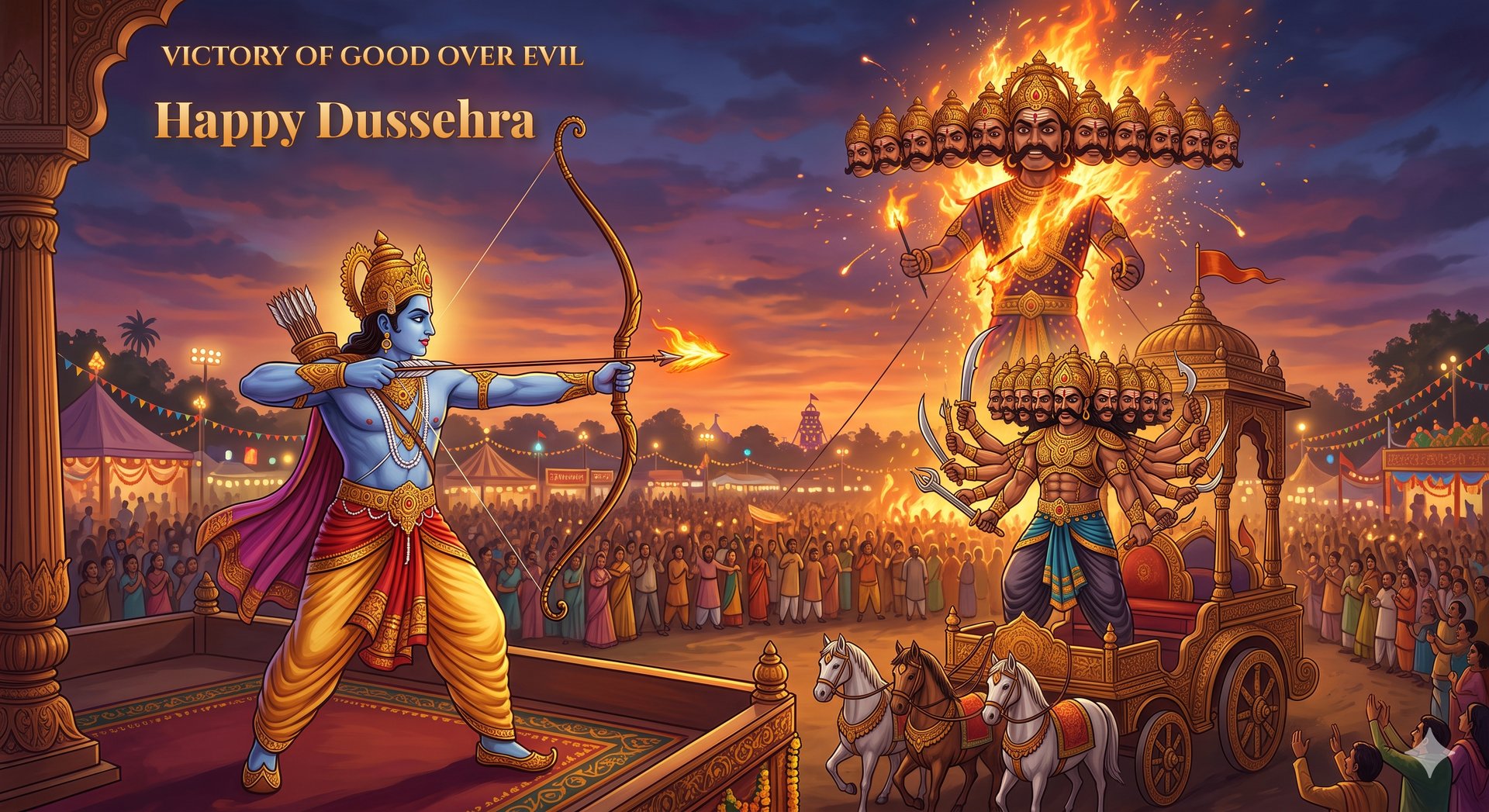
Every autumn, as the monsoon clouds retreat and the crisp breeze of the Hindu lunar month of Ashwin settles over the subcontinent, millions gather to celebrate Dussehra, also known as Vijayadashami. Observed on the tenth day (Dashami) following the nine vibrant nights of Navratri, the festival stands as one of South Asia's most profound cultural milestones. While its rituals vary dramatically from the Himalayan valleys to the southern coasts, its heartbeat remains unchanged: whatever the odds, righteousness (dharma) and truth ultimately prevail over arrogance and tyranny.
The Roots and Legends of Victory
The word Dussehra draws its roots from the Sanskrit words dasha (ten) and hara (defeat), while Vijayadashami translates directly to "the tenth day of victory". Three distinct mythological threads weave together to give this day its sacred weight.
The first and most widely enacted legend comes from the Sanskrit epic Ramayana. After the ten-headed king of Lanka, Ravana, abducted Sita, Lord Rama—accompanied by his brother Lakshmana, the devoted Hanuman, and an army of vanaras—waged a fierce battle to rescue her. Despite Ravana's immense scholarship and power, his hubris and moral transgression led to his downfall on the tenth day of battle, when Rama vanquished him using the divine Brahmastra.
Simultaneously, the festival honors the Divine Feminine. According to Puranic tradition, when the shape-shifting buffalo demon Mahishasura unleashed chaos across the heavens and earth, the gods combined their energies to manifest Goddess Durga. After nine days and nights of relentless combat, Durga slew Mahishasura on the tenth day, restoring cosmic balance.
A third tradition connects the day to the epic Mahabharata. Having completed their mandatory year of exile in disguise (Agnyatavasa), the Pandava princes retrieved their celestial weapons—which they had hidden inside the hollow of a sacred Shami tree—and declared their true identities before emerging victorious in battle. To this day, worshipping the Shami tree and exchanging its leaves (or apta leaves in Maharashtra) as tokens of "gold" and goodwill remains a cherished custom.
One Festival, Many Expressions
Few festivals showcase India's cultural diversity quite like Dussehra, transforming the landscape into a living mosaic of theatre, devotion, and community.
Ramlila and Ravana Dahan in the North Across northern and western India, neighborhoods come alive for over a week with Ramlila—dramatic folk reenactments of the Ramayana recognized by UNESCO as an Intangible Cultural Heritage of Humanity. On the evening of Dussehra, thousands pack into open grounds to witness Ravana Dahan, where towering effigies of Ravana, his brother Kumbhakarna, and his son Meghanada are set ablaze against the night sky.
Bijoya Dashami in the East In West Bengal, Odisha, and Assam, the day marks the emotional culmination of Durga Puja. Married women smear vermilion on the idol and one another in the joyful ritual of Sindoor Khela before bidding tearful farewells to the Goddess during the Visarjan (immersion) processions. Afterward, communities embrace, exchange greetings of Shubho Bijoya, and share festive sweets.
Royal Grandeur, Golu, and Learning in the South In Karnataka, Mysuru Dasara dazzles visitors with an illuminated palace and the grand Jamboo Savari procession, where the idol of Goddess Chamundeshwari is carried atop a caparisoned elephant. Across Tamil Nadu, Andhra Pradesh, and Telangana, homes display Bommai Golu or Bommala Koluvu—intricate tiered arrangements of dolls depicting mythological and everyday scenes. In Kerala and across the southern states, Vijayadashami is celebrated as Vidyarambham, an auspicious morning when toddlers trace their first letters in rice or sand, marking the beginning of formal education.
Kullu's Gathering of Deities
Unlike the rest of the country, where Dussehra marks the end of festivities, Himachal Pradesh's week-long Kullu Dussehra begins on Vijayadashami, as hundreds of richly decorated village deities are carried down mountain trails in palanquins to pay homage to Lord Raghunath.
Gratitude for the Tools of Life
Beyond epic battles, Vijayadashami is deeply rooted in mindfulness and gratitude toward the instruments that sustain human life. Through Ayudha Puja and Shastra Puja, artisans, engineers, students, farmers, and musicians clean and worship their tools, vehicles, ploughs, musical instruments, and books. By pausing to honor the everyday objects of labor and learning, the festival bridges the spiritual and the practical, reminding everyone that work performed with integrity is its own form of worship.
Conquering the Ten Heads Within
In the modern world, the burning of Ravana's effigy is more than an ancient spectacle; it is a mirror for self-reflection. According to philosophical tradition, Ravana's ten heads symbolize ten destructive human impulses: kama (lust), krodha (anger), moha (delusion), lobha (greed), mada (pride), matsarya (envy), swartha (selfishness), anyaya (injustice), amanavta (cruelty), and ahankara (ego).
Even Ravana's vast knowledge could not save him once ego clouded his conscience. As communities increasingly shift toward eco-friendly effigies and low-smoke celebrations to protect the environment, the core invitation of Dussehra grows clearer: true victory does not lie merely in setting paper and bamboo alight, but in kindling wisdom, humility, and compassion within ourselves. Marking the twenty-day countdown to Diwali, Dussehra clears away the shadows of the past so that the light of renewal can find its way home.